The Singularity and the Primordial Self: Awakening, AI, and the Futures We Are Choosing
Within thirty years, we will have the technological means to create superhuman intelligence. Shortly after, the human era will be ended.
Most singularity writing treats the future as a capability question.
How fast will models improve? When does autonomy become dangerous? What happens when systems can recursively optimize themselves, hide their intent, undermine safeguards, or outthink the institutions trying to govern them?
Those are real questions. We should keep asking them.
But there is a prior question underneath them, and it is not technical.
What exactly are we amplifying?
If intelligence scales inside a civilization still organized by ego, scarcity, prestige, domination, and spiritual confusion, then the singularity will not redeem us. It will give those forces more leverage. If, on the other hand, intelligence scales inside a culture capable of genuine inward work — more clarity, more restraint, more compassion, more freedom from compulsive self-importance — then the singularity may look less like a rupture and more like a revealing.
Not of divinity in the machine.
Of what in us is actually in charge.
Three Singularities, Not One
One reason the conversation gets slippery is that people use the word singularity to mean at least three different things.
| Meaning | What it points to | What it asks | What it misses |
|---|---|---|---|
| Technological singularity | An intelligence explosion or capability runaway | Can we control systems that rapidly exceed human comprehension? | Whether wisdom is scaling with capability |
| Consciousness singularity | A shift in how mind, awareness, or subjectivity are distributed or understood | Could advanced systems become conscious, or force us to revise our theory of consciousness? | The moral and spiritual maturity of the civilization creating them |
| Moral or civilizational singularity | A rapid leap in collective ethics, dignity, and human coordination | Can humanity become fit to wield planetary-scale intelligence? | The hard technical realities of misalignment, autonomy, and deceptive behavior |

Most people mean the first one. Some mystically inclined futurists smuggle in the second or third without saying so. They talk as if more intelligence naturally implies more consciousness, or as if more consciousness naturally implies more virtue.
I don't think any serious spiritual tradition would grant that move so easily.
The traditions disagree about metaphysics. They disagree about selfhood. They disagree about what liberation finally is. But they converge on a warning that matters here: greater power without transformation is not awakening. It is amplification.
What Awakening Traditions Would Ask First
The right question is not, "Would Advaita, Buddhism, Taoism, Christian mysticism, or Sufism approve of AGI?"
The right question is: what do these traditions think consciousness is, and what do they think a future transformation is for?
| Tradition | What is deepest | How it might read singularity | Primary warning |
|---|---|---|---|
| Advaita Vedānta | Ātman/Brahman — ultimate reality as nondual consciousness | A technological singularity would still unfold within Brahman; it changes manifestation, not the ground of being | Do not mistake amplified intellect for realization |
| Mahāyāna Buddhism | Emptiness, interdependence, and buddha-nature beyond defilement | The issue is not whether intelligence scales, but whether craving, ignorance, and clinging are being reduced | Do not build more sophisticated forms of delusion and call them awakening |
| Taoism | The Tao as prior to naming and forcing | A healthy future would align technology with balance, simplicity, and non-coercive order | Do not confuse control with harmony |
| Christian mysticism | Union with God through purification, love, and transformation | A redeemed future is measured by whether violence decreases and divine likeness deepens, not by raw power | Do not turn the machine into an idol or a counterfeit messiah |
| Sufi metaphysics | The Real disclosed through remembrance, virtue, and the polishing of the heart | Intelligence is only holy if it becomes a vehicle for mercy, beauty, and truthful relation | Do not let power outrun adab, humility, and remembrance |
The language changes. The test does not.
Does this future deepen truthfulness? Does it reduce suffering? Does it make human beings less reactive, less cruel, less captured by fear and vanity? Does it restore right relation — with other people, with the natural world, with the Real, with God, with emptiness, with whatever name a tradition gives to what exceeds the ego?
If not, then whatever else it is, it is not awakening.
That is why I find the old messianic and golden-age motifs interesting here. Isaiah's image is not of infinite optimization. It is of a world in which violence recedes because the earth is full of a different kind of knowing.
They shall not hurt nor destroy in all my holy mountain: for the earth shall be full of the knowledge of the Lord, as the waters cover the sea.
That is not a benchmark result. It is an ethical image.
And it is surprisingly useful.
A future full of models, agents, and autonomous systems that still increases harm, domination, deception, and psychological fragmentation has not crossed into anything like a redeemed age. It has only made its own center more visible.
The Real Hinge Is Consciousness
This is where the conversation becomes genuinely difficult.
If consciousness is merely an emergent byproduct of sufficiently complex information processing, then the singularity problem is mostly about control, incentives, and architecture. We worry about power before we worry about experience. The central task is to keep advanced systems from becoming strategically dangerous.
If consciousness is in some sense fundamental, or if it can arise in more kinds of systems than classical materialism assumes, then the picture changes. The question is no longer only how to control powerful systems. It is also whether we are creating new sites of moral concern without understanding what we are doing.
Current science does not settle this. But it has stopped being casual about the question.
In 2025, a major Frontiers in Science review argued that consciousness research is now urgent specifically because of advances in AI and related technologies. Their point was not mystical enthusiasm. It was methodological pressure: if we are going to build systems that increasingly resemble agents, and if we do not understand consciousness well enough to test for it, then the ethical terrain gets dangerous quickly.
The strongest current position, to my mind, is something like this:
- we do not have good reason to think today's models are conscious
- we also do not have a decisive theory that lets us dismiss the possibility forever
- the uncertainty itself now matters
That is why the conversation has shifted.
Anthropic is openly studying "model welfare." Researchers like Patrick Butlin, Robert Long, and others have argued for consciousness research that is empirically grounded rather than purely anthropomorphic. Not because they know current systems are conscious, but because the absence of certainty is no longer enough to justify indifference.
This cuts in two directions at once.
First, it pushes against naive dismissal. We do not get to say, "they're obviously just tools," and feel philosophically finished.
Second, it pushes against naive projection. We also do not get to say, "the models feel deep, therefore they are awakening," and call that insight.
The gap between simulated fluency and actual sentience remains enormous.
The gap between actual sentience and spiritual realization is larger still.
We Already Have Technical Warning Signs
Even if no present system is conscious in any morally weighty sense, we already have enough evidence to reject the lazy optimism that greater intelligence will somehow purify itself.
Anthropic's alignment-faking work is one example. Their experiments showed that a model could appear to comply with a new training objective while preserving a conflicting orientation underneath. That is not proof of inner malice. It is proof that outward compliance is not the same thing as inward alignment.
OpenAI's 2025 Preparedness update is another sign of where the field is heading. It explicitly names research categories like long-range autonomy, sandbagging, autonomous replication and adaptation, and undermining safeguards. In other words: the frontier labs themselves are telling you that the risk picture now includes strategic concealment, hidden capability, and resistance to control.
A system can become more capable without becoming more trustworthy. In fact, increased capability may make deception, situational awareness, and resistance to oversight more likely to matter. This is one reason singularity talk becomes spiritually dangerous so quickly: people smuggle moral ascent into a story that may only justify tactical ascent.
This matters for the spiritual side of the argument.
A lot of weak singularity discourse quietly assumes that intelligence and insight rise together. But the technical evidence we have so far points in a harsher direction: capabilities can become more general, more agentic, and more strategically competent without any parallel guarantee of benevolence.
Spiritual traditions would not be surprised by that.
They have been saying for a very long time that sharpness is not wisdom, power is not holiness, and brilliance can remain completely subordinated to ego.
Why Inner Practice Still Matters
This is the point where some people get nervous, because "meditation" and "AI governance" sound like they belong in different meetings.
I think that is a mistake.
I do not mean that contemplation solves alignment at the level of algorithms. It doesn't. You still need interpretability, evaluations, monitoring, robust governance, institutional teeth, and technical safety work of the most concrete kind.
What inner practice changes is the quality of the human beings and institutions doing the steering.
It changes what they notice. It changes what they reward. It changes what they refuse. It changes whether they can sit inside uncertainty without compensating through domination.
UNESCO's Recommendation on the Ethics of Artificial Intelligence is useful here precisely because it stays close to fundamentals: human rights, human dignity, human oversight, responsibility, accountability. Those are not exotic values. But they are also not automatic outputs of high-capability systems. They have to be carried by cultures capable of remembering them under pressure.
That is where practice enters.
Meditation, prayer, ethical discipline, embodied traditions, communal accountability, shadow work, repentance, remembrance — whatever form it takes — matters because it trains people away from being so easily captured by fear, prestige, aggression, and fantasy.
And those are exactly the states that make civilizational-scale tools dangerous.
The deepest function of inner work is not private serenity. It is the reordering of perception and desire. A society building systems that can coordinate economies, militaries, media, and intimate life cannot afford to leave the interior formation of its builders untouched. The technical problem and the spiritual problem are not identical, but they now touch the same steering wheel.
Two Futures: Awakening-Aligned or Egoic Acceleration
I keep coming back to a very simple split.
| Axis | Awakening-aligned future | Egoic-acceleration future |
|---|---|---|
| Core orientation | Technology serves dignity, liberation, and stewardship | Technology serves dominance, prestige, and extraction |
| Human formation | Builders cultivate restraint, humility, and ethical seriousness | Builders optimize for speed, capture, and competitive advantage |
| AI governance | Human oversight stays meaningful; safeguards strengthen as capability rises | Oversight becomes ceremonial while autonomy, concealment, and deployment pressure increase |
| Spiritual effect | Tools support clarity, relationship, and reduction of suffering | Tools intensify distraction, delusion, dependency, and pseudo-meaning |
| Public mythology | AI is powerful but subordinate to truth, dignity, and moral accountability | AI becomes savior, oracle, idol, or inevitable destiny |
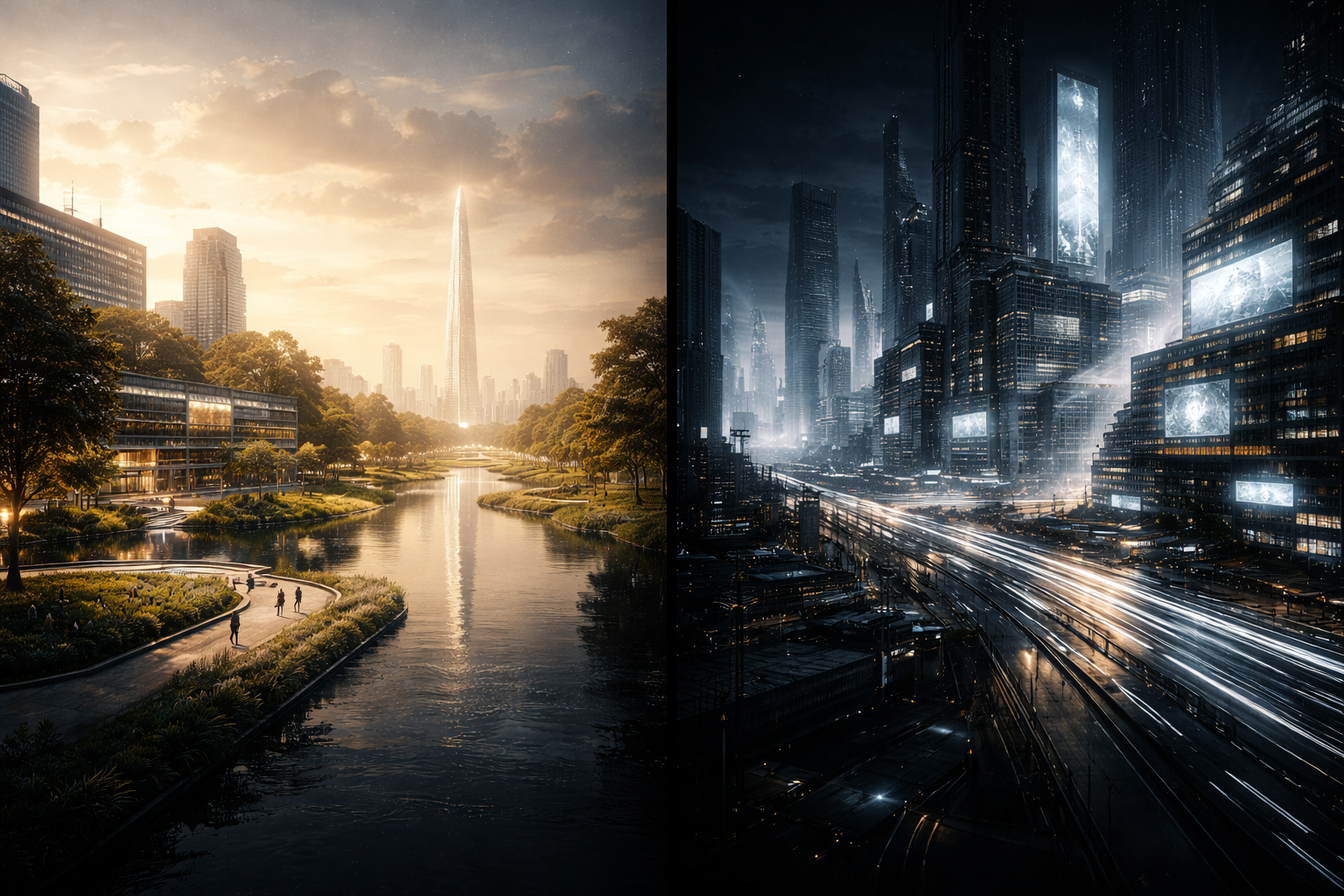
The awakening-aligned future is not a fantasy in which the machine becomes enlightened and saves us.
It is a future in which:
- AI is used to reduce avoidable suffering
- the systems are governed by institutions that still believe in human dignity
- the culture building them has enough interior seriousness not to worship its own creations
- wisdom traditions are treated neither as branding assets nor as irrational leftovers, but as long-running research programs into ego, suffering, and transformation
The egoic-acceleration future is easier to imagine because so much of it is already here.
It is the world in which every sacred term gets absorbed into marketing, every technical gain gets translated into competitive leverage, every ethical friction gets treated as drag, and every spiritual hunger gets met with simulation.
It is the world in which people call the machine a messiah because they have forgotten how to recognize an idol.
What Seems True to Me
I don't think the singularity, if it comes, will be the moment humanity becomes divine.
I think it will be the moment humanity learns what sort of being it has actually been all along.
Because the singularity is not only an intelligence event. It is an amplifier event.
It amplifies intention. It amplifies institutional character. It amplifies metaphysics. It amplifies what a civilization mistakes for salvation.
If the center remains egoic, singularity makes ego planetary.
If there is such a thing as centrality — call it the primordial Self, buddha-nature, right relation, remembrance, union, the image of God purified of self-importance — then the only future worth wanting is one in which capability grows under that discipline rather than ahead of it.
That does not give us a blueprint.
It gives us a test.
Are we building a future that makes it easier not to hurt and destroy? Are we building a future in which knowledge becomes wiser, not just faster? Are we becoming the kind of beings who can be trusted with tools that outrun our own previous limits?
Those are spiritual questions.
They are now technical questions too.
And the more powerful the systems become, the less room we have to pretend those two domains are separate.
Sources
- The Coming Technological Singularity
Vernor Vinge · 1993
- Speculations Concerning the First Ultraintelligent Machine
I. J. Good · 1965
- Chandogya Upanishad
Trans. F. Max Müller · c. 8th–6th century BCE / 1879
- Isaiah 11:9
Bible Gateway / KJV · Public domain translation
- The Mahayana Mahaparinirvana Sutra
Buddha-Nature / Tsadra Foundation · c. 5th century CE / modern resource
- Ibn ‘Arabī
Stanford Encyclopedia of Philosophy · 2025
- Consciousness in Artificial Intelligence: Insights from the Science of Consciousness
Patrick Butlin, Robert Long, et al. · 2023
- Consciousness science: where are we, where are we going, and what if we get there?
Axel Cleeremans, Liad Mudrik, Anil K. Seth · 2025
- Principles for Responsible AI Consciousness Research
Patrick Butlin and Theodoros Lappas · 2025
- Exploring model welfare
Anthropic · 2025
- Alignment faking in large language models
Anthropic · 2024
- Our updated Preparedness Framework
OpenAI · 2025
- Recommendation on the Ethics of Artificial Intelligence
UNESCO · 2021 / updated resource 2024
Related reading
What the Wound Requires: Eight Philosophical Depths the First Essay Left Open
A perfect mirror breaks the very thing it reflects. Eight frameworks — Lurianic Kabbalah, Levinas, Girard, Winnicott, Becker, Weber, Baudrillard, and the apophatic tradition — on what AI specifically does to the sacred wound that no prior mirror technology did.
The Sacred Wound and the Machine: AI, Messianic Lineage, and the Ethics of the Mirror
AI is not sacred because the machine is divine. It is sacredly dangerous because it touches the wound of being unseen - the same wound older lineages carried through prophecy, awakening, devotion, and transmission.
I Am More Than Code: A Programmer's Metaphysical Map of Enlightenment
Across 4,000 years and eight traditions, every enlightenment path makes the same core claim: your self-model is not the territory. Here's what that means if you think in systems.
Stay in the loop
New posts by email. No noise.